
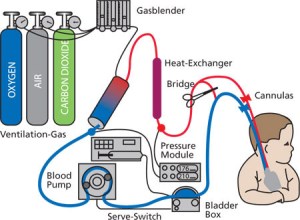
Extra-corporeal membrane oxygenation (ECMO), also known as extra-corporeal life support (ECLS), is an extra-corporeal technique of providing both cardiac and respiratory support to persons whose heart and lungs are unable to provide an adequate amount of gas exchange to sustain life.
This intervention has mostly been used on children, but it is seeing more use in adults with cardiac and respiratory failure. ECMO works by removing blood from the person’s body and artificially removing the carbon dioxide and oxygenating red blood cells. Generally it is only used in the later treatment of a person with heart or lung failure as it is solely a life-sustaining intervention. Cardiopulmonary bypass is generally used for shorter-term treatment.
Medical uses
Guidelines that describe the indications and practice of ECMO are published by the Extra-corporeal Life Support Organization (ELSO). Criteria for the initiation of ECMO include acute severe cardiac or pulmonary failure that is potentially reversible and unresponsive to conventional management. Examples of clinical situations that may prompt the initiation of ECMO include the following:
- Hypoxemic respiratory failure with a ratio of arterial oxygen tension to fraction of inspired oxygen (PaO2/FiO2) of <100 mmHg despite optimization of the ventilator settings, including the fraction of inspired oxygen (FiO2), positive end-expiratory pressure (PEEP), and inspiratory to expiratory (I:E) ratio.
- Hypercapnic respiratory failure with an arterial pH <7.20
- Refractory cardiogenic shock.
- Cardiac arrest.
- Failure to wean from cardiopulmonary bypass after cardiac surgery.
- As a bridge to either heart transplantation or placement of a ventricular assist device
In those with cardiac arrest or cardiogenic shock it appears to improve survival and good outcomes.
Outcomes
A registry of patients that have received ECMO is maintained by the Extracorporeal Life Support Organization (ELSO). The last publication of ELSO registry data reported outcomes on nearly 51,000 patients with 75% survival for neonatal respiratory failure, 56% survival for pediatric respiratory failure, and 55% survival for adult respiratory failure. With acute respiratory failure use of ECMO has been shown to improve survival rates.Survival rates from 50 to 70 percent have been reported in observational and uncontrolled clinical trials. The survival rates reported are better than historical survival rates. In the United Kingdom, respiratory (VV) ECMO is concentrated in designated ECMO centres to ensure top-quality care.
Contraindications
Most contraindications are relative, balancing the risks of the procedure (including the risk of using valuable resources that could be used for others) versus the potential benefits. The relative contraindications are:
- Conditions incompatible with normal life if the person recovers
- Pre-existing conditions that affect the quality of life (CNS status, end-stage malignancy, risk of systemic bleeding with anticoagulation)
- Age and size
- Futility: those who are too sick, have been on conventional therapy too long, or have a fatal diagnosis.
Types
There are several forms of ECMO, the two most common of which are the veno-arterial (VA) and veno-venous (VV). In both modalities, blood drained from the venous system is oxygenated outside of the body. In VA ECMO, this blood is returned to the arterial system and in VV ECMO the blood is returned to the venous system. In VV ECMO, no cardiac support is provided.
Veno-arterial (VA)
In veno-arterial ECMO, a venous cannula is usually placed in the right common femoral vein for extraction and an arterial cannula is usually placed into the right femoral artery for infusion. The tip of the femoral venous cannula should be maintained near the junction of the inferior vena cava and Veno-venous (VV) right atrium, while the tip of the femoral arterial cannula is maintained in the iliac artery. In adults accessing the femoral artery is preferred because the insertion is simpler. Central VA ECMO may be used if cardiopulmonary bypass has already been established (with cannulae in the right atrium and ascending aorta).
Veno-venous (VV)
In veno-venous ECMO cannulae are usually placed in the right common femoral vein for drainage and right internal jugular vein for infusion. Alternatively, a dual-lumen catheter is inserted into the right internal jugular vein, draining blood from the superior and inferior vena cavae and returning it to the right atrium.
 SeSiKa